
Author: Joel Sandaluk
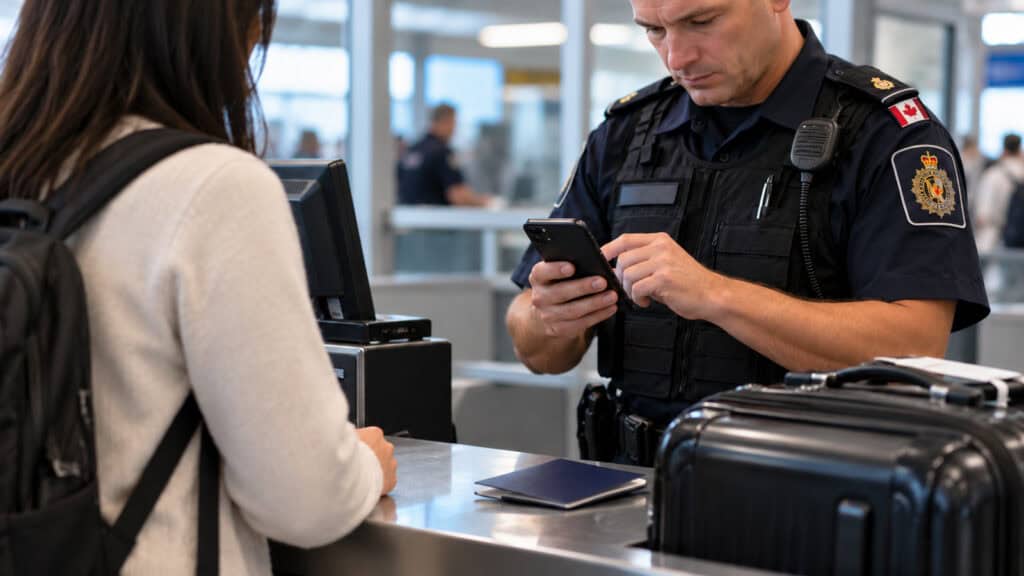
I was recently interviewed by CTV News about searches of travellers’ electronic devices, such as cellphones, tablets, etc at the Canada-US border.
How a Phone Search at the Border Can Go Wrong
Over the years, I have seen a number of clients who had incriminating, or at least suspicious, material on their phones when they were examined at the border. On one occasion, a client had emails from a prospective employer confirming details like salary and when they would be available to start work. This led to a lengthy examination about the client’s intentions in coming to Canada and eventually broadened into an investigation that included contacting the prospective employer.
I have also seen this happen to people travelling to the United States. In one case, a young woman had her cell phone searched and messages sent through an online service revealed that she had been in an intimate relationship with a man that could be interpreted to be transactional in nature. She was denied admission to the United States on the basis that she was likely to engage in “commercialized vice” while in the country, a humiliating experience.
What Happens If a Border Officer Finds Something on Your Phone?
When a search of an electronic device at the border goes poorly, there are a number of possible outcomes. Sometimes, the person may simply be able to credibly explain what the officer has found. For example, someone might be coming to Canada to visit a serious girlfriend, but only for a brief visit. They may understand the nature of the sponsorship process and intend to pursue it properly in accordance with Canadian immigration law subsequent to their arrival. In that situation, they may be able to explain messages or other information on their phone that discloses a long term plan to live with their girlfriend in Canada in a way that addresses the officer’s concerns.
Unfortunately, this is not always what happens. A person may be given the opportunity to withdraw their application for admission to Canada and be turned around at the border, or in a more serious case, they may be found inadmissible to Canada because the officer does not believe that they are a genuine visitor. There may also be an allegation of inadmissibility if the officer believes that the person misrepresented or withheld material facts when they were questioned at the port of entry. A finding of inadmissibility for misrepresentation can result in a person being barred from Canada for five years.
How to Prepare Your Phone Before Crossing the Border
Whenever I have clients who intend to cross an international border, I advise them to be mindful of the fact that border officers may have the authority to search their electronic devices and that what an officer finds may have serious consequences. For clients travelling to the United States, I also suggest that they look at their social media accounts and consider whether something they have posted could be viewed negatively or misunderstood by a border officer.
Ultimately, though, my advice is very simple: be open and honest with border officers and answer their questions as clearly and simply as possible.
My advice to people planning to travel in the near future is to remember that they may be subject to a search at the border and that their electronic devices may be searched as easily as their carry-on bags and luggage. In the same way that you would make sure you had not inadvertently left something prohibited, like a pocket knife, in your carry-on baggage, you should be mindful of what is on your phone and other electronic devices and whether something there could be interpreted in a way that might prejudice your application for admission to Canada, or to another country for that matter.
Refused Entry to Canada After a Phone Search? What You Can Do
If somebody has already been denied admission to Canada as a result of a search of their electronic device, the first thing I want to know is precisely why they were refused. That can mean obtaining the written reasons for the refusal and, where appropriate, filing an application for judicial review. I want to understand not only what the officer saw on the device, but how the officer interpreted it and what conclusions they drew from it.
Once we understand that, we can determine whether there is a basis to challenge those conclusions as unreasonable or otherwise legally erroneous. Alternatively, if the person prefers to make a subsequent application to come to Canada, we can prepare that application in a way that directly addresses any misunderstandings or misconceptions that arose during the previous attempt to enter Canada.
Concerned About What Could Happen at the Border?
If you have been refused entry to Canada or the United States following a search of your phone or other electronic device, or you are worried about an immigration issue before you travel, Mamann Sandaluk LLP can help.
We can determine what went wrong at the border and advise you about what to do before you try to cross again.
Contact Mamann Sandaluk LLP to speak with one of our immigration lawyers.
Frequently Asked Questions:
Can U.S. border officers search my phone without a reason?
Yes. U.S. border officers have broad authority to inspect travellers and their belongings at the border, and that can include electronic devices such as cellphones, tablets and laptops. A phone search does not necessarily mean that an officer believes you have committed a crime.
For Canadians travelling to the United States, the more immediate concern is often immigration. Information on a phone can cause an officer to question why you are travelling, whether you intend to work without authorization, whether you genuinely intend to leave the United States at the end of your visit, or whether there is some other reason you may not be admissible.
That is why I tell clients to think about their electronic devices much as they would their luggage: be mindful of what you are carrying across the border.
Can I refuse to unlock my phone at the U.S. border?
You can refuse to provide access to your phone, but refusing may have consequences.
This is particularly important for Canadians and other foreign nationals seeking admission to the United States. A foreign national does not have an absolute right to enter the United States. If you refuse to cooperate with an examination, you may face additional questioning, your device may potentially be seized, and the refusal may complicate your application for admission.
If something on your device could create an immigration problem, trying to deal with that problem for the first time while being questioned by a border officer is not optimal.
Can my phone be searched at U.S. preclearance in a Canadian airport?
Yes, electronic-device searches can arise during the U.S. preclearance process at Canadian airports. When you go through U.S. preclearance, you are being examined for admission to the United States before you board your flight.
The fact that you are physically in Canada is important because U.S. preclearance in Canada operates under a specific legal framework. Your rights and the officer’s powers are therefore not necessarily identical to what they would be after you have arrived at a port of entry geographically in the United States.
But from a traveller’s perspective, the message is the same: don’t assume your phone is off-limits simply because you are still physically in Canada.
What are border officers looking for when they search a phone?
There is no single thing that border officers are looking for. From an immigration perspective, however, they are often looking for information that helps them decide whether what a traveller is telling them is true and whether they should be admitted.
For example, emails discussing a new job could raise concerns that someone intends to work without authorization. Messages about moving in with a partner could lead to questions about whether someone genuinely intends to make only a temporary visit. Other communications, photographs or social-media activity could raise very different admissibility concerns.
My advice is always very simple: answer questions honestly, clearly and simply. An attempt to conceal or misrepresent something can create a much more serious immigration problem than the information that initially attracted the officer’s attention.
What happens if I am refused entry after a phone search?
If you have been refused entry after a phone search, the first thing I would want to know is exactly why. What did the officer find? What questions were you asked? What did you say? And, most importantly, what conclusion did the officer reach?
Once we know that, we can determine what options are available. In a Canadian case, that could mean obtaining the officer’s records, challenging the decision in Federal Court where there are proper grounds to do so, or dealing directly with the officer’s concerns in a new application.
If you were refused admission to the United States, it is equally important to understand precisely what happened and the basis for the refusal before simply trying to cross again.
In either situation, keep every document you were given at the border and get legal advice before your next attempt to enter.